
Early Flowers in Northern Cyprus: Anemones and Other Winter-Spring Plants
Northern Cyprus is beautiful at any time of year, but the island truly stuns with its beauty in the spring when nature comes to life. In spring, the island's flora is a paradise for botanists and those who love photography or painting, with nearly 2,000 species of wildflowers found here.
Anemones (most commonly Anemone coronaria) usually appear after the first steady winter rains and bloom en masse from January to April; they fade faster in sunny spots, while they last longer in cool and higher-altitude areas. They are easiest to spot in open fields and open woodlands near the foothills of the Kyrenia Range and on the Mesaoria Plain.

- Types of anemones
- When anemones bloom in Northern Cyprus
- Where to see anemones in the wild in Northern Cyprus
- Other early flowers of Northern Cyprus
- "Cyprus orchids": what they are and when to look for them
- How to view flowers without harming nature
- Useful services for bloom-watching trips
- Frequently Asked Questions
Types of anemones
The word "anemone" encompasses many species. In Northern Cyprus and across the island in general, "wild anemones" usually refers to the Poppy Anemone (Anemone coronaria): it is this species that creates vivid "carpets" of red, white, lilac, and blue flowers during the green season.
For practical purposes, it is convenient to categorize anemones as follows:
- Mediterranean tuberous (including Anemone coronaria) — for flower beds, pots, and cutting; active during the cool season and go into summer dormancy.
- Woodland/groundcover — usually prefer partial shade and moister soil; in Northern Cyprus, they are typically grown in sheltered spots (without overheating or drying out).
- Autumn (Japanese and hybrids) — bloom later but tolerate hot, dry summers poorly without regular watering and mulch.

When anemones bloom in Northern Cyprus
In the climate of Northern Cyprus, anemones "turn on" after the winter rains: they grow leaves in the cool weather and bloom for several months. The peak depends on the weather of a specific year, the altitude above sea level, and how exposed the location is to sun and wind.
| Period | What happens | Commentary |
|---|---|---|
| November – December | Start of green growth | After the first steady rains and cool nights. |
| January – April | Main blooming period | Often earlier on the plains; later and longer near the foothills and higher up. |
| April – May | End of blooming, seed ripening | They fade faster in direct sun. |
| May – September | Dormancy | The above-ground part usually disappears in the heat, while the tuber remains in the soil. |
Where to see anemones in the wild in Northern Cyprus
Wild anemones are most often found where the green cover persists in winter and early spring: open fields, forest edges, sparse olive groves, rocky slopes, and areas with soil that doesn't dry out too early. For Northern Cyprus, a typical scenario involves "patches" and "carpets" on the Mesaoria Plain, in the Karpaz, and near the foothills of the Kyrenia Range (especially in spots with open sun and short grass).
If you are planning a walk to see the blooms, it is usually best to choose:
- Fields and open spaces near low hills (greenery appears there faster after rains);
- Olive groves and open woodland (flowers often grow in "islands" between trees);
- Areas that aren't overly trampled near secondary roads (but be sure to park without driving onto green verges).
Other early flowers of Northern Cyprus
If the goal is to see the "green season" in all its glory, anemones alone are usually enough for several outings: different altitudes and exposures provide different timing. However, other winter-spring flowers are often found alongside them.
- Cyprus Cyclamen (Cyclamen cyprium) — the island's endemic; in nature, it usually blooms from autumn to mid-winter, most often in mountainous and shady places where moisture lingers longer.

- Cyprus Tulip (Tulipa cypria) — a rare and protected endemic, usually blooming in March–April. In Northern Cyprus, it is associated with areas of Kormakitis and parts of the Kyrenia Range. Observation should be done carefully, without entering the growth areas.

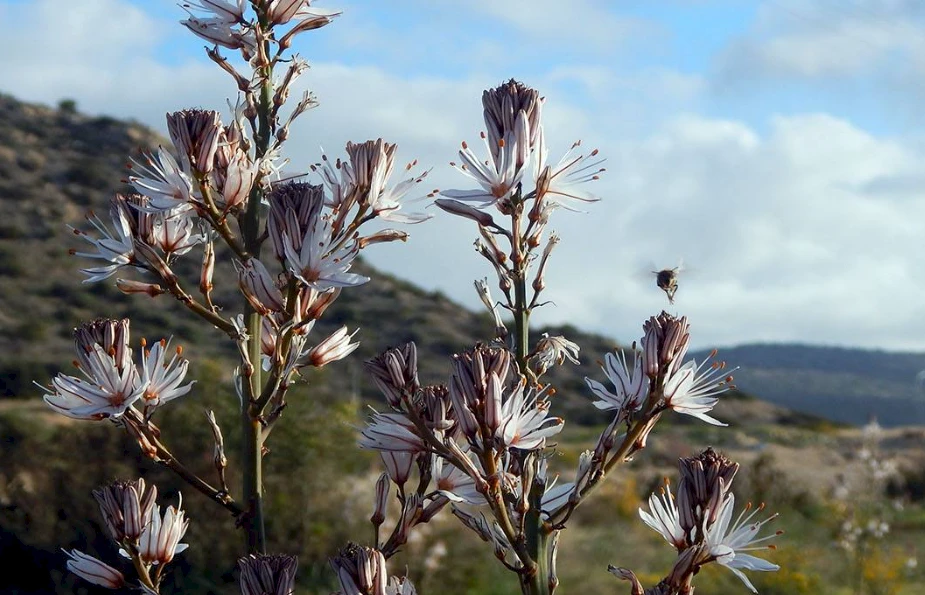
- Asphodel (Asphodelus) — noticeable "candles"; they often appear in fields and on slopes during the green period and last until spring.
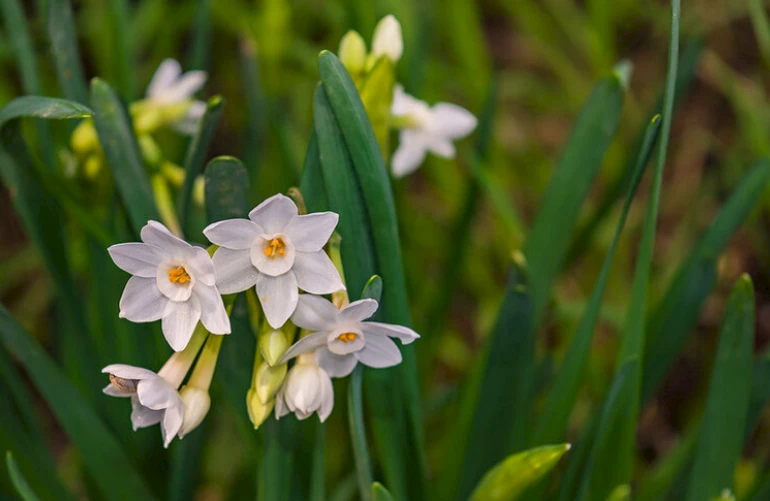
- Daffodils (wild species) — found in winter and early spring, especially after rains, in "damper" spots.
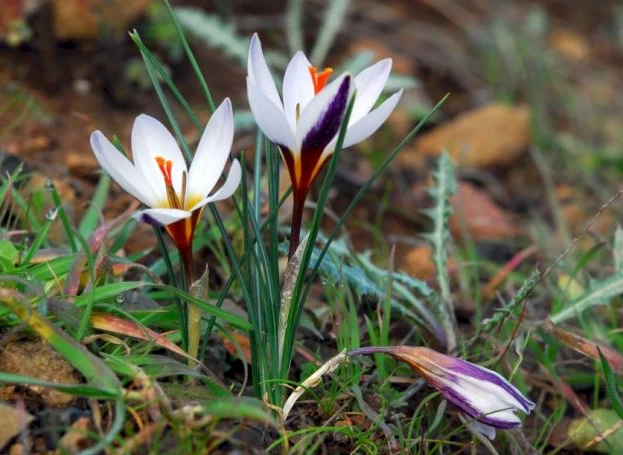
- Crocuses — early flowers of the cool season; more noticeable in cooler regions and at higher altitudes.
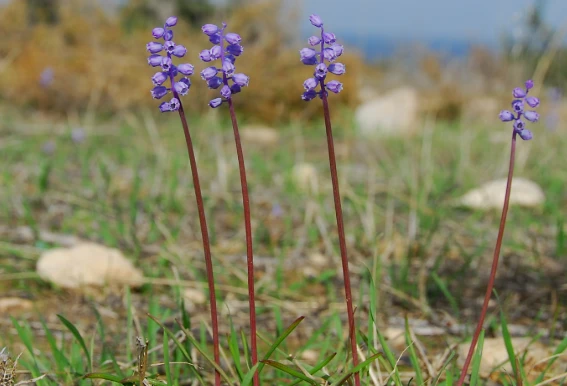
- Muscari (Grape Hyacinth) — small blue "brushes," often blooming alongside other spring wildflowers.
"Cyprus orchids": what they are and when to look for them
In common parlance, "Cyprus orchid" often refers to bee orchids of the genus Ophrys. One of the most famous is Ophrys kotschyi (an island endemic): its flower mimics an insect and attracts pollinators through "deception"—using shape and signals similar to pheromones.
Seasonally, these orchids usually appear in late winter and spring. They are most often sought on sunny slopes, in areas with limestone soils and short grass. These are plants that are best left untouched: observe and photograph from a distance.

How to view flowers without harming nature
- Walk on trails and do not step into dense "carpets" of flowers: the soil and bulbous/tuberous plants are easily damaged.
- Do not pick and certainly do not dig up wild plants: rare species on the island occur locally and recover slowly.
- If you are taking photos, it is better to crouch nearby and shoot at an angle than to "set up the shot" by breaking the grass around it.
- Do not move plants "to the garden" from nature: it is safer for the home to buy tubers/bulbs from a seller than to remove a wild one.
Useful services for bloom-watching trips
If you are planning a trip to see the blooms for a day or a weekend, it is sometimes more convenient to arrange logistics in advance.
- If you would like to add a guided walk or a tour of natural sites to your trip, you can check options on Tripster or Sputnik8.
- If you plan to travel around the island by car, you can compare rental options via Localrent.
Frequently Asked Questions
When is the best time to see anemones in Northern Cyprus?
Most often — from January to April. In warm years, the first mass fields appear earlier, while in cooler and higher-altitude locations, the season shifts closer to March–April.
Why are there many anemones one year and fewer the next?
The main factor is rainfall and the distribution of precipitation in winter. If rains come in "waves" followed by mild cool weather, the blooming is usually stronger and lasts longer.
Can I transplant wild anemones into my garden?
It is not recommended. For home growing, it is safer to buy tubers/bulbs. Moving plants from nature often results in the death of the plant and damage to the growing site.
How do I know when to "send my anemones to rest" at home?
After blooming, the leaves begin to yellow and die back. At this point, watering is gradually reduced: the tuber must go into a dry summer period to bloom properly next season.
What other flowers should I look for along with anemones?
Asphodel, muscari, crocuses, and wild daffodils are often found nearby. In late winter and spring, orchids of the genus Ophrys are sometimes found on sunny slopes.
Can the Cyprus Tulip (Tulipa cypria) be seen in Northern Cyprus?
Yes, the species is associated with specific areas of the island, including the northwest and parts of the Kyrenia Range. This is a rare protected plant: it should not be picked or dug up, but observed from a distance.
Author

I am a person who is not afraid to change life when my heart tells me that something greater lies ahead. I am originally from Belarus. I have journeyed from pedagogical and economic education to the financial sector and many years of work in logistics — a world where everything moves, changes,…
You may also be interested in:
- Do you need to notify the veterinary service if your pet has died in Northern Cyprus?
- Where to buy party supplies in Northern Cyprus
- Where to buy horse riding tack and equipment in Northern Cyprus
- Идеи подарков на День святого Валентина на Северном Кипре
- Year of the Red Fire Horse 2026: how to celebrate, what to wear, and what to give