In the Footsteps of Aphrodite in Cyprus
Legends of Aphrodite in the Republic of Cyprus: What the Island Tells
Aphrodite is not just a “postcard story,” but a collection of legends tied to specific places: the birth of the goddess from sea foam at the rocks, her bathing in the shade of Akamas, talisman stones on the shore, and the paths lovers walk as if repeating an ancient ritual.

Birth from the Foam
The most famous legend begins where the sea is more than just the sea. The ancients said: on a certain day, the water raised white foam, and from this foam — like from light — Aphrodite appeared. Not as a baby, but already as the world remembered her: calm, radiant, slightly detached, as if she belongs neither to time nor to humans, yet knows how to be closer than anyone.
In Cyprus, this story is told not as a sensation, but as a local weather fact. They say, sometimes the sea “plays” differently here, the water is especially milky near the rocks, here a wave pauses — and you involuntarily think: maybe the myth wasn’t invented, but just very accurately described a rare state of nature?
And there is one more important detail. Aphrodite’s birth is not only about love. It’s about the fact that beauty is not always gentle. It is born from the elements — and therefore contains strength. Love can be tender, but it can also be an ocean that decides for itself.
Aphrodite’s Stone and “Rituals”
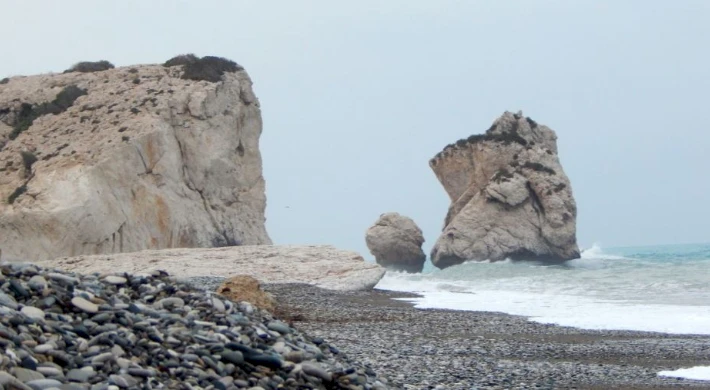
Legends like to attach themselves to stones — stones don’t argue, don’t age, don’t change address. On the coast near Paphos, there is a rock called Aphrodite’s Stone. Around it, an entire “folk ritual” has grown, lasting for generations.
There is a popular tradition associated with Petra tou Romiou: “swim around the rock three times” — for luck in love. It’s important to understand: this is not a mandatory part of visiting, nor a “rule of the place.” In practice, the meaning of such actions is often different: to pause, formulate a wish, release the unnecessary, and simply live the moment by the sea.
People look for small smooth stones on the shore — “Aphrodite’s stones” — and take them as talismans. In fact, it’s not an “official artifact,” but a legend doesn’t need a seal. A legend works when you invest meaning into it.

The Bath and the Human Aphrodite
The second major legendary spot is the Bath of Aphrodite, most often associated with the Akamas Peninsula. According to legend, the goddess came here to bathe, hide from prying eyes, and be herself — without temples, hymns, or crowds.
In such stories, Aphrodite unexpectedly becomes very human — a woman in need of a place of silence. And this is why the legend resonates strongly: we too seek a corner where we can exhale, where no one demands conformity, where you are obliged to prove nothing.
They say the water in the bath “preserves youth.” But if you set aside the magic, what remains is more precise: such places really “preserve” — not the face, but the state of being. There it’s easier to remember that beauty is not a filter, but calmness. That love is not a dramatic plot, but the ability to be near without destroying yourself.
Loutra tis Afroditis — a small natural grotto in the green area of Akamas. Legend makes it a place of the goddess’s solitude and links it to the story of Aphrodite and Adonis meeting.
Adonis and the Shadow of Love

According to Cypriot legend, the story of Aphrodite and Adonis is a love in which beauty is always near fragility. Adonis comes into the world in an unusual way — as if nature itself “births” him, and the goddess of love protects him from the first days, hiding him from prying eyes and raising him as the most precious.
When Adonis grows up, he chooses to be with Aphrodite, but their happiness is short-lived. During a hunt, Adonis is fatally wounded by a wild animal, and the goddess, hearing his cry, runs to him through rocks and thorns. Where drops of blood fall to the ground, red flowers are said to bloom — as a memory of a love that was bright but could not overcome fate.
And here too is the Cypriot character: the island can be sunny while remembering that the sun does not erase shadows.
The Aphrodite Trail: A Road That Teaches to See
There are legends not about a point on the map, but about the journey. The “Aphrodite Trail” is no longer a single ancient legend, but a modern tradition grown from the myth: to walk a route where the sea and mountains constantly change places, and the horizon seems to “pull” the mind.
In myths, the road is always a test. But for Aphrodite, the test is different: not strength, courage, or victory. The test is attentiveness. To see beauty without greed. To wish without destruction. To love without control.
Palaepaphos (Kouklia): Temple Aphrodite and the Cult of Life
Palaepaphos (Kouklia) — a place where myth becomes history. Here Aphrodite matters not as a “patron of dating,” but as part of an ancient cult: fertility, continuation of life, harmony, and desire as a force that moves the world.
Legends of her sanctuaries often sound like stories of a place where people asked not “for him/her to return,” but for warmth in the home, for family not to break apart, for children to be born, for the land to yield crops, for the heart not to empty.
And here the myth grows up. Because adult love is not always brightness. Sometimes it is resilience. And when you read these stories, Cyprus starts to seem like an island not “about romance,” but “about life.”
Main Aphrodite Sites in the Republic of Cyprus
| Place | Time to Allocate | What to Do There |
|---|---|---|
| Petra tou Romiou | 20–60 minutes | Viewpoints, walk along the shore, photos at sunrise/sunset; swimming only when the sea is calm |
| Loutra tis Afroditis | 30–90 minutes (without trails) | Short walk to the grotto, botanical garden, start of hiking routes in Akamas |
| Aphrodite Trail | 3–4 hours | Panoramic views of the sea and hills, natural spots, walk “through the landscape of the myth” |
| Palaipafos | 60–120 minutes | Archaeological complex and museum; context of Aphrodite worship as a force of fertility and life |
Official reference: description of the trail on the Republic of Cyprus tourism portal — Aphrodite (Circular) – Akamas Forest Nature Trail.
Author

I am a person who is not afraid to change life when my heart tells me that something greater lies ahead. I am originally from Belarus. I have journeyed from pedagogical and economic education to the financial sector and many years of work in logistics — a world where everything moves, changes,…