
Two major water reservoirs commissioned in Nicosia: water supply for more than 36 hours
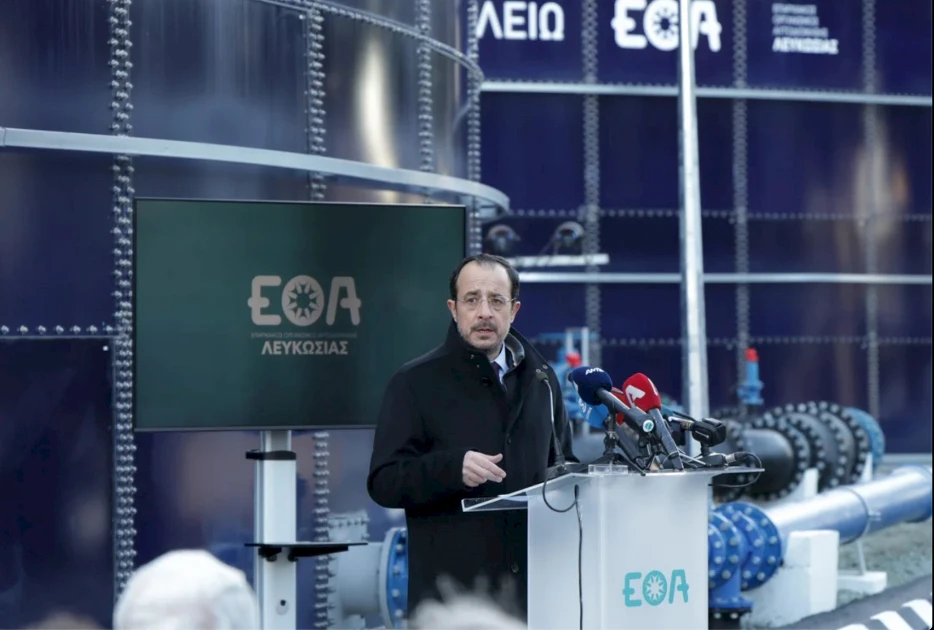
Two new water storage reservoirs, each with a capacity of 17,200 cubic meters, were officially inaugurated in Nicosia. The ceremony took place on Monday at the premises of the Nicosia District Local Government Organisation (EOA) with the participation of the President of Cyprus, Nikos Christodoulides.
As the head of state noted, the project significantly enhances the capital’s water security. In the event of supply disruptions, the city will be able to rely on reserves for more than 36 hours, which is especially important in the context of climate change and increasingly frequent drought periods.
The president stressed that the project is of strategic importance not only for Nicosia but for the entire country, as water security is directly linked to national resilience and autonomy. The new reservoirs, named “Kleo” and “Eratos,” substantially strengthen the capacity for safe water storage and distribution in areas with growing demand. He recalled that the idea for these reservoirs emerged even before the current water crisis and forms part of a broader state strategy, which includes:
- increasing available water volumes through non-traditional sources,
- expanding and modernising storage and transport infrastructure,
- reducing water consumption.
According to the president, Cyprus remains one of the EU countries with the highest levels of water consumption — in some areas exceeding 500 litres per person per day — which he described as unjustified. The government’s goal is to reduce consumption by at least 10%.
Key measures also include:
- the launch of mobile and small-scale desalination units,
- abandoning the previous practice of shutting down desalination plants during rainfall,
- the commissioning by March 2026 of mobile desalination units in Garylli and the port of Limassol, increasing desalinated water production by approximately 20%.
It is expected that, once all planned projects are completed, around 80% of the country’s water needs will be covered by desalination, including with the support of the United Arab Emirates.
Additionally, the government plans to invest more than €200 million in water supply projects and network modernisation between 2024 and 2030. This is particularly relevant given that in some areas water losses in networks reach 40%.
The head of the Nicosia district, Constantinos Yorkadjis, also noted that in the context of the climate crisis, creating water reserves is not a choice but a necessity. He stressed that the authorities’ goal is to ensure uninterrupted water supply for households, schools and businesses, especially in the rapidly developing areas of western Nicosia and Lakatamia.
Author

I am originally from St. Petersburg — a city with a unique character and rhythm. My professional life began rapidly: at just 16, I plunged into the world of global events. The World Cup, the roar of Formula 1 cars in Sochi, the energy of VK Fest, and the backstage of Fashion Week — I always…
You may also be interested in:
- Cyprus successfully performs cochlear implantation on children aged 7 months for the first time
- Man arrested in Larnaca for machete attack: victim loses finger
- Damage discovered in physiotherapy room in Paphos, possibly due to gunshots
- Cyprus police warn of a new type of online visa scam
- Illegal tourist apartments remain a problem: the law does not allow on-site inspections
