
Halloumi — Cyprus cheese: how it is prepared and served
Halloumi (also spelled halloumi or hellim) is a traditional Cypriot cheese, widely popular in the countries of the Eastern Mediterranean. It is a true gastronomic symbol of the island of Cyprus.
The cheese is made from a mixture of goat's and sheep's milk, sometimes with the addition of cow's milk. The curd is heated to a cheese-like consistency, then placed in brine. Halloumi has a white color, a firm, slightly layered texture, and a pronounced milky aroma.
- What is halloumi
- How halloumi is prepared
- Salads with halloumi
- Baked dishes with halloumi
- Desserts with halloumi
What is halloumi
Halloumi is produced both by small farms and large dairy enterprises. In stores, the cheese can be found either in bulk or in factory-packaged 250-gram portions. It is usually stored in brine, which helps preserve the freshness and softness of the product.
Halloumi usually has a mild, slightly salty taste, though saltier varieties also exist. Sometimes, layers of cheese may contain mint leaves — they not only add aroma but also serve as a natural antiseptic.
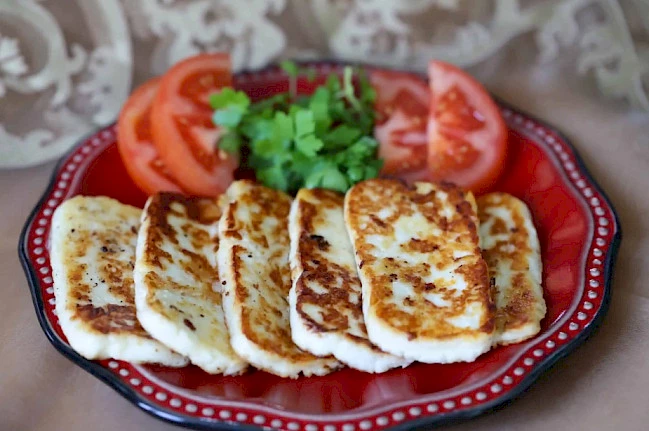
A unique feature of halloumi is its high melting point. This makes it suitable for grilling or frying: the cheese does not melt but develops a golden crust while keeping a tender interior.
How halloumi is prepared in Cyprus
- with vegetables;
- in salads;
- in baked dishes;
- in desserts.
Halloumi with vegetables
Traditionally, halloumi is grilled, but at home a regular frying pan works perfectly. Slice the cheese about 1 cm thick and place it on a heated surface — this helps it brown faster. Vegetable or butter can be used for frying.
Serve halloumi with fresh or sautéed vegetables, nuts, or fruits. Try combinations with figs, tomatoes, basil, or watermelon — classic Cypriot pairings.
Salads with halloumi
Halloumi is perfect for vegetable salads — it can be found in almost every restaurant in Cyprus. For example, to prepare a salad for two at home, you will need:
- a 250 g pack of halloumi (mildly salted),
- 1 small onion,
- half a can of sweet corn,
- 8–10 lettuce leaves,
- 1 large tomato or 5–6 cherry tomatoes,
- 1 cucumber,
- 1 bell pepper,
- black pepper and olive oil to taste.
Fry the halloumi, add chopped vegetables, and dress with oil or your favorite sauce. This salad is light, filling, and perfect for the hot Cypriot climate.
Baked dishes with halloumi
Halloumi is often used in gözleme — Turkish flatbreads popular in Northern Cyprus. The cheese is paired with spinach, greens, or egg. Halloumi is also added to pies and pastries, replacing traditional cheeses like feta.
Fun fact: in Cypriot bakeries, you can find “halloumi pie” — a soft pie with cheese and greens, often served with coffee or mint tea.
Desserts with halloumi
A less known but equally delicious option is desserts with halloumi. One of the most popular is künefe — a hot Eastern dessert made from thin kadayif pastry layers and halloumi or other soft cheese. After baking, the dessert is poured with hot syrup.
This dessert is served in Turkish and Arabic cafés across Cyprus, often with ice cream or pistachios.
Interesting facts about halloumi
- Since 2021, halloumi has received PDO (Protected Designation of Origin) status in the EU — now only cheese produced in Cyprus according to the traditional recipe can be called “Halloumi.”
- Cypriots eat halloumi not only at lunch but also for breakfast — it is often fried and served with eggs.
- Annual halloumi festivals are held on the island, where dozens of variations of this cheese with herbs, nuts, and even honey can be tasted.
Author

I am a person who is not afraid to change life when my heart tells me that something greater lies ahead. I am originally from Belarus. I have journeyed from pedagogical and economic education to the financial sector and many years of work in logistics — a world where everything moves, changes,…