
Polish archaeological mission completed the 2025 excavation season in Lower Paphos
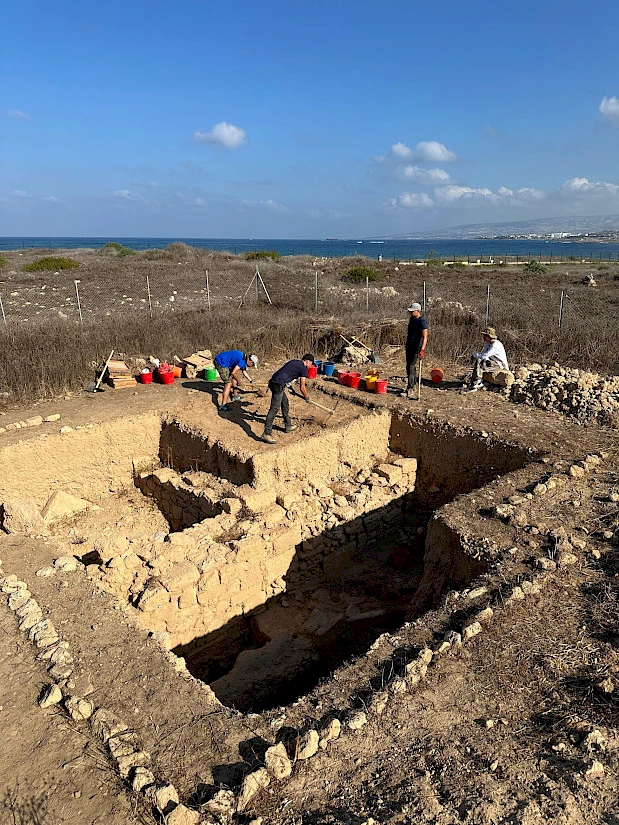
The joint archaeological mission of the University of Warsaw and Jagiellonian University in Krakow in Lower Paphos for 2025 has concluded. The research was conducted under the direction of Professor Evdoksia Papuci-Vladika, with the participation of specialists from the Warsaw University of Technology, the University of Hamburg, Wroclaw University of Science and Technology, and the National Museum of Krakow.
The year 2025 was symbolic for Polish archaeology in Cyprus: it marked 60 years of research in the Malutena area and 15 years of excavations at the Agora of ancient Paphos.
Findings in Malutena
Excavations focused on trench MAL TT.X, where well-preserved architectural remains of the late Hellenistic period were uncovered. Among the most significant finds was a sealed amphora handle with the name of Rhodes of the eponymous archon Aristombrotidas, dated approximately to 117 BCE.
Archaeologists also discovered fragments of crucibles for metal smelting, indicating the existence of a craft or production complex in the area.
Research at the Agora
In the northern part of the Eastern Stoa of the ancient Agora, the base of a previously unknown colonnade was identified, with remains of two fluted columns dating to an earlier construction phase.
Additionally, archaeologists found a settling pool from the first half of the 2nd century BCE, which was connected to a well via a clay water conduit.
Study and conservation
Alongside the excavations, detailed documentation of about 350 architectural elements from residential complexes in the area, including the Theseus Villa and the House of Aeon, was carried out. At the Archaeological Museum of Paphos, specialists conserved 71 coins and metal objects, including a fragment of gold foil and a handle of a bronze situla.
Anniversary year for Polish archaeology
As part of the 2025 anniversary events, the IV International Nea Paphos Colloquium took place in Warsaw and Krakow, along with the photo exhibition “From Malutena to the Agora” at the En Plo Gallery.
Additionally, the Research Division of the Polish Centre of Mediterranean Archaeology of the University of Warsaw was officially opened in Paphos, marking an important step in strengthening scientific cooperation between Poland and Cyprus.
Author

I am originally from St. Petersburg — a city with a unique character and rhythm. My professional life began rapidly: at just 16, I plunged into the world of global events. The World Cup, the roar of Formula 1 cars in Sochi, the energy of VK Fest, and the backstage of Fashion Week — I always…
You may also be interested in:
- Fire hazard in Cyprus intensifies due to strong winds
- Christodoulides to discuss Europe-Gulf cooperation at forum in Athens
- Cyprus assures that EU e-prescriptions will not cause drug shortages
- Cyprus approves construction of its first crematorium
- Scientists discover traces of hantavirus in semen six years after infection
