
Ancient City of Vouni — What to See and How to Get There in Northern Cyprus
Vouni is one of the most interesting archaeological sites in the western part of Northern Cyprus. People come here for the ruins of a palace complex from the 5th–4th centuries BC, panoramic views of the coast, Soli, and Petra tou Limnidi. A visit usually takes 1–1.5 hours. According to current official information, a full ticket costs 150 TL, and a student ticket costs 50 TL. Opening hours are from 08:00 to 18:00, with last entry at 17:00.
Below is what has survived in Vouni, how to get there, what to pay attention to before the trip, and which locations are convenient to combine with this route.
- What Vouni is and where it is located
- What to see in Vouni
- Brief history of the complex
- Practical information for visiting
- How to get to Vouni
- What to see nearby
- Useful services
- Frequently asked questions
What Vouni is and where it is located
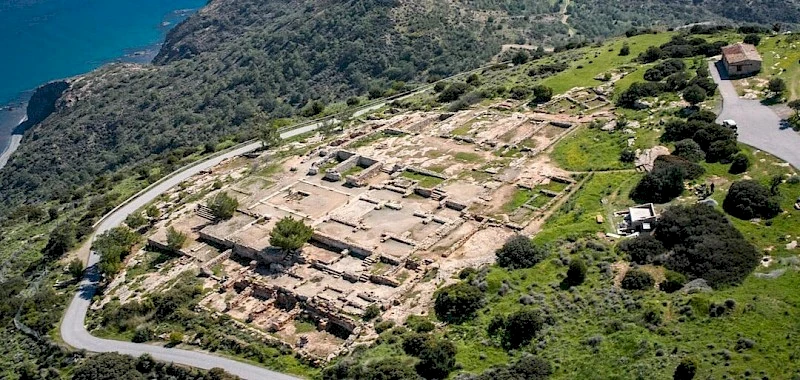
Vouni is an archaeological complex on a hill west of Gemiçonağı and Lefke, near the village of Yeşilırmak in Northern Cyprus. In Russian-language materials it is often called the “Palace of Vouni,” but for a traveler it is first and foremost an open archaeological site with the ruins of a large fortified complex and one of the best viewpoints in the region.
The site is located about 9 km west of Gemiçonağı. From the hill, you can clearly see the coastline, the surroundings of Soli, and the islet of Petra tou Limnidi. That is why Vouni is convenient to view in two roles at once: as a historical monument and as one of the best viewpoints in Northern Cyprus.
What to see in Vouni
Ruins of the palace complex
The main reason to visit is the remains of a large complex that occupied the terraces of the hill and included dozens of rooms. Today, the foundation lines, inner courtyards, service areas, passageways, and the overall scale of the development are clearly visible. Even without a deep interest in archaeology, it is easy to understand that this was not a separate tower or temple, but a large center with a carefully planned layout.
Temple at the upper point of the hill
In the upper part of the complex stood a temple usually associated with Athena. For tourists, this is an important point on the route not only because of its historical significance, but also because of the panorama: from here, the sea, the road below, and the overall relief of the western part of the region are best seen.
Panoramic view of the coast
Even if you compare Vouni with other archaeological zones of Northern Cyprus, its strength is not only the ruins but also its location. It is worth coming here for the combination of history and views. That is why the complex fits well with a trip to the ancient city of Soli and to the sea in the Lefke area.
Traces of engineering solutions
When talking about Vouni, people often separately mention the cistern, the water supply system, and the remains of a bath block. This makes the site more interesting for those who like not only the “overall view of ruins,” but also the details of everyday life in an ancient complex.
Brief history of the complex
The palace of Vouni appeared around 500 BC, during the period when Cyprus was under the rule of the Persian Empire. The center of Persian administration at that time was ancient Marion — present-day Polis in the territory of the modern Republic of Cyprus. After the uprising of the inhabitants of Soli, the Persians decided to build a strategic palace complex nearby, which made it possible to control the coast and observe the city from a height of about 250 meters above sea level. Thanks to this location, Vouni offered a view of the sea and the surrounding territories, which made it both a residence and a fortified observation point.
The main entrance to the palace was on the sea side, reached by a wide stone staircase, part of which has survived to this day. Later, after the arrival of the Greeks and the weakening of Persian influence, the complex was repeatedly rebuilt and gradually acquired features of ancient Greek architecture. Around 380 BC, the palace was destroyed by fire and was never restored.
During excavations in Vouni, archaeologists found pottery, amphorae, jewelry, household items, elements of sanctuaries, fragments of the water supply system, and ancient coins. These finds helped reconstruct the layout of the palace, understand the daily life of its inhabitants, and confirm Vouni’s connections with other cities of Cyprus and the Mediterranean. Some artifacts were discovered not only in the palace itself but also on the lower terrace, where residential buildings were located. A significant part of the research was carried out by a Swedish archaeological expedition in the mid-20th century, which made it possible to reconstruct the layout of the complex and the history of its development.
Practical information for visiting
How much time to allow
A visit usually takes 1–1.5 hours. If you like photography and want to walk through all the terraces at a relaxed pace, you can allow up to 2 hours.
Prices and visiting hours
| Parameter | Value | Comment |
|---|---|---|
| Full ticket | 150 TL | Current rate |
| Student ticket | 50 TL | It is better to have a document confirming eligibility for the discount |
| Opening hours | 08:00–18:00 | Last entry is at 17:00 |
What is important to know before the trip
- the ticket office is at the top, right by the complex, not at the lower turn;
- the road to the site is narrow and steep in places;
- in hot weather it is better to go in the morning or closer to evening;
- there is almost no shade on the open hill, so water and a hat are really needed;
- if you arrive shortly before closing, the gates may no longer allow cars up the hill.
Is there parking
Yes, the complex has a small parking area. Usually there are enough spaces, as Vouni is not yet among the most crowded attractions in Northern Cyprus.
How to get to Vouni
By car
This is the most convenient option. From the main Lefke–Yeşilırmak road there is a turnoff to the complex, after which a narrow ascent to the hill begins. Location.
If you are building a day trip, Vouni is convenient to combine with Soli, Petra tou Limnidi, and the beaches in the Lefke area.
By public transport
There is no convenient direct public transport to the complex itself. The practical scenario is usually this: first get to Güzelyurt, then transfer to a bus toward Lefke, get off closer to the turnoff, and then look for a taxi. The last stretch can be walked, but the climb up the hill is noticeable, especially in summer.
How to do it
- Travel to Güzelyurt from Nicosia or Kyrenia.
- Transfer to a service heading toward Lefke.
- Get off at the turnoff to the road to Vouni.
- Cover the last stretch by taxi or on foot if the weather and physical effort are comfortable for you.
- Check your return transport in advance, because there are fewer services in the evening.
For transfers and route planning, these instructions may be useful: how to get between Güzelyurt and Nicosia and how to get between Güzelyurt and Kyrenia.
What to see nearby
The most logical combination is a trip to the ancient city of Soli. Historically, these places are closely connected, and logistically they are convenient to visit on the same day. If you want to add a natural point, pay attention to Petra tou Limnidi. To finish the route by the sea, the beaches in the Lefke area are suitable.
If you are interested in museums in the urban part of the route, you can add the Güzelyurt Archaeology Museum.
Useful services
If you plan to see Vouni, Soli, and the Lefke coast in one day, it is more convenient to go by car. You can compare rental options here: Localrent.
If you need a hotel or apartment in the western part of Northern Cyprus for 1–2 nights, you can check options here: Trip.com.
If you need travel medical insurance, you can check policy options here: EKTA Traveling.
Frequently asked questions
Where is the ancient city of Vouni located?
Vouni is located west of Gemiçonağı and Lefke, on a hill near Yeşilırmak in the western part of Northern Cyprus.
How much time do you need to visit Vouni?
Usually 1–1.5 hours is enough. If you go without rushing and take a lot of photos, you can allow up to 2 hours.
What is Vouni most interesting for?
The main reasons to visit are the ruins of a large 5th–4th century BC complex and the panoramic view of the coast, Soli, and Petra tou Limnidi.
Can you get to Vouni without a car?
Yes, but not directly. Usually people travel with a transfer via Güzelyurt and Lefke, and cover the last part by taxi or on foot.
Is there parking at Vouni?
Yes, there is a small parking area near the complex.
How much does a ticket to Vouni cost?
According to current official information, a full ticket costs 100 TL, and a student ticket costs 50 TL.
Can Vouni and Soli be combined in one day?
Yes, this is one of the most convenient routes in the western part of Northern Cyprus, especially if you are traveling by car.
Author

I am a person who is not afraid to change life when my heart tells me that something greater lies ahead. I am originally from Belarus. I have journeyed from pedagogical and economic education to the financial sector and many years of work in logistics — a world where everything moves, changes,…