
Cyprus Before the Elections: Balance Without a Leader and a Bet on Foreign Policy
Political Uncertainty in Cyprus: Pre-Election Analysis
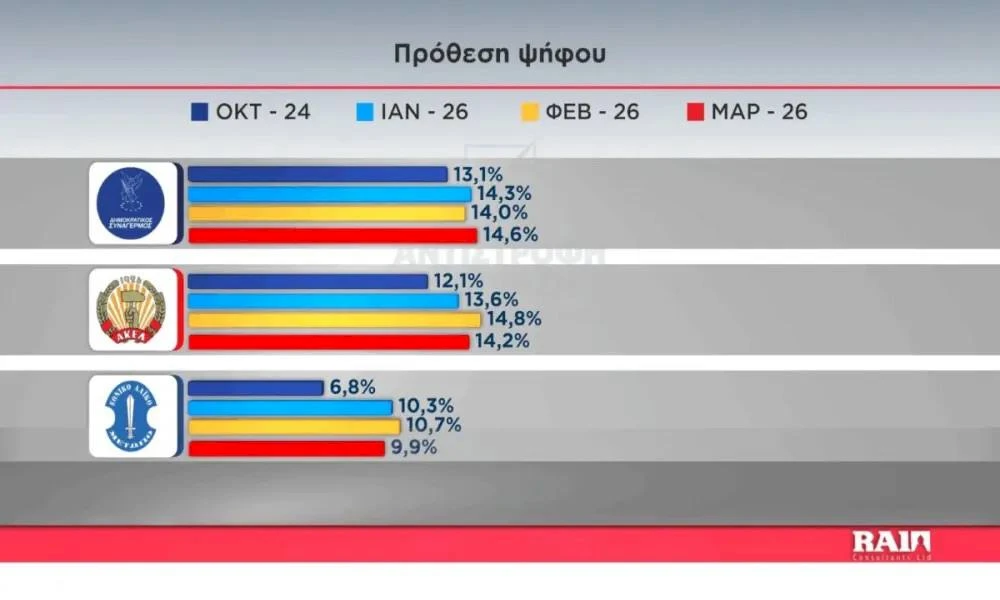
If parliamentary elections were held in Cyprus tomorrow, the country would approach them in a state of political uncertainty. None of the parties demonstrate a confident lead, and a significant part of society is effectively distancing itself from the political system.
Party Ratings and New Players
According to the latest poll, the leaders are distributed as follows:
- Democratic Rally (DISY) — 14.6%
- AKEL — 14.2%
- ELAM — 9.9%
The 0.4% gap between the leaders highlights the fragility of the current balance. However, the main intrigue of the campaign is not in the struggle of traditional parties, but in the growth of new players. "ALMA" is already gaining 7.4%, and "Direct Democracy of Cyprus" — 6.8%, actively pulling voters away from the old political forces. This indicates a noticeable erosion of the habitual party system.
Crisis of Trust and Selection Factors
More than half of those surveyed — 57% — are actually not ready to support any of the parties.
At the same time, political alienation remains extremely high. The level of trust in political institutions also remains at a minimum: only 17% express satisfaction, while the vast majority — 84% — are dissatisfied.
Voters are increasingly focusing not on party programs, but on personalities. Already 40% of respondents state that the candidate is the key factor in their choice. Three themes dominate the public agenda:
- Economy
- The Cyprus Issue
- Corruption
Against this background, a relatively high mobilization of supporters of individual parties stands out. ELAM has the most disciplined electorate, followed by AKEL and DISY. This means that final results may differ significantly from current ratings.
President's Positions: Internal and External Split
The dynamics of attitudes toward the country's president — Nikos Christodoulides — deserve special attention. His position has strengthened noticeably over the last month: the approval rating rose to 39%. Nevertheless, most citizens still evaluate his work critically.
The reason for this duality is the gap between domestic and foreign policy. While dissatisfaction prevails within the country, on the international stage, the president's actions are perceived much more positively. More than half of citizens approve of the foreign policy course.
This was especially evident in the context of the Middle East crisis and events related to Iran. The government's actions received support from the majority of the population, as did measures to strengthen security. The support of allies also played a significant role: the reaction of Greece and European countries was met with high approval. The military presence of partners and the strengthening of defense cooperation increased the sense of security among citizens, temporarily boosting trust in the government.
Digital Transformation and Conclusions
In parallel, the nature of political struggle is changing. Social media are becoming a key tool for influencing voters. Facebook remains the main platform, while new political forces prove to be the most active in the digital space.
In conclusion, Cyprus approaches potential elections in a state of transition. The old party system is losing stability, new players are gaining strength, and voters are increasingly making choices in a situational and personalized manner.
Foreign policy successes provide the authorities with a temporary resource of trust, but they do not compensate for the deep internal crisis. It is this contradiction — between external consolidation and internal mistrust — that will be the main factor in future elections.
Author

Born in the city of shipbuilders, Mykolaiv (Ukraine). Currently living in Moscow. Diplomat in reserve. More than 10 years of experience in the Mediterranean region (Greece, Cyprus). Until 2015, First Secretary of the Russian Embassy in Cyprus. Fluent in Greek and English. Completed civil service in…
